
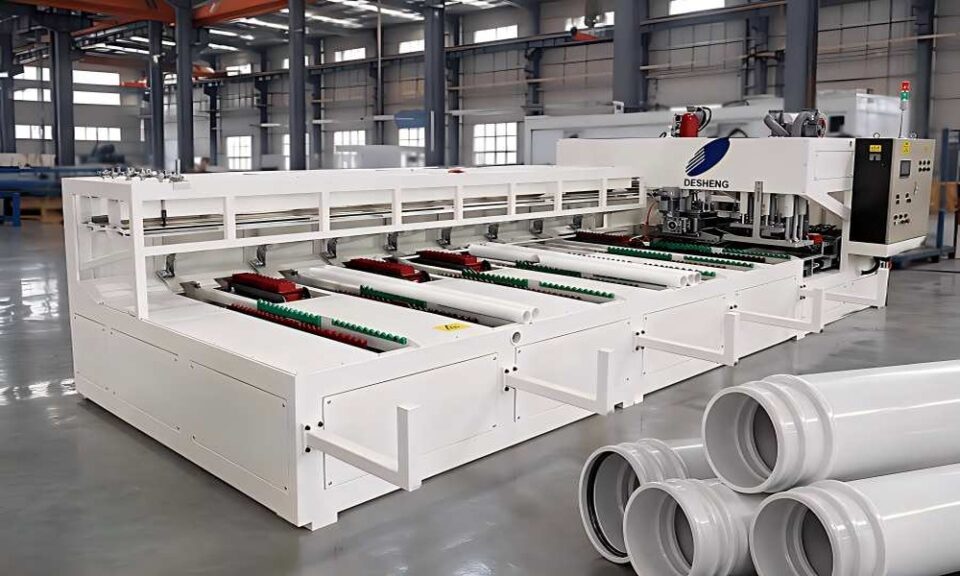
PVC pipe manufacturers need faster output, stable quality, and lower production costs. A belling machine helps achieve these goals by automating the socket-forming process at the end of PVC pipes.
What Is Pipe Belling?
Pipe belling is the process of heating one end of a PVC pipe and forming it into a socket. This socket allows pipes to connect more easily during installation. In water supply, drainage, irrigation, and conduit applications, socket quality directly affects sealing performance and installation efficiency.
Faster Production Cycles
Manual belling is slow and depends heavily on operator skill. Workers must heat the pipe end, place it into the mold, form the socket, cool it, and remove the finished pipe. Each step takes time and may create inconsistent results.
A modern automatic belling machine can complete heating, forming, cooling, and discharge in a controlled cycle. This reduces manual handling and allows manufacturers to process more pipes within the same working hours. For factories with large orders, this directly improves delivery capacity.
More Consistent Socket Quality
Socket accuracy is one of the most important factors in PVC pipe production. If the socket is too loose, the pipe connection may leak. If it is too tight, installation becomes difficult. Poor socket shape can also lead to customer complaints and product returns.
Belling machines use controlled heating, accurate molds, and stable forming pressure to produce sockets with consistent dimensions. This improves roundness, socket depth, wall thickness, and surface finish. As a result, manufacturers can maintain stable quality across large production batches.
Reduced Labor Costs
Labor is a major cost in pipe manufacturing. Manual socket forming requires experienced workers, and quality may vary from one operator to another. Automated belling reduces dependence on manual labor and simplifies daily operation.
Operators mainly need to set parameters, monitor machine performance, and inspect finished pipes. This allows manufacturers to use labor more efficiently, reduce worker fatigue, and lower the risk of human error during long shifts.
Lower Scrap and Rework
Defects such as uneven sockets, cracks, deformation, burning, or poor sealing surfaces often come from unstable heating and forming. These problems increase scrap rates and waste raw materials.
A belling machine improves process control by keeping heating time, temperature, forming pressure, and cooling time consistent. This helps reduce rejected products and minimizes the need for rework. For manufacturers, lower scrap means better material utilization and higher profit margins.
Better Integration with Production Lines
Efficiency depends not only on one machine but also on the whole production line. Belling machines can be integrated with extrusion lines, cutting machines, haul-off units, and stacking systems. This creates a smoother workflow from pipe extrusion to final socket forming.
For companies investing in plastic pipe machinery, belling equipment is an important part of building a more automated and efficient production system. It reduces transfer time between processes and supports continuous production planning.
Flexibility for Different Pipe Requirements
Different pipe applications require different socket types. PVC water supply pipes, drainage pipes, electrical conduits, and irrigation pipes may use different socket structures. Belling machines can support various socket types, including U-type, R-type, rectangular, and rubber ring sockets.
This flexibility helps manufacturers respond to different customer requirements without changing the entire production setup. It also allows factories to expand their product range and serve more market segments.
Improved Delivery Reliability
For B2B buyers, stable delivery is just as important as product quality. Delays can affect construction schedules, distributor inventory, and long-term cooperation. By improving socket-forming speed and reducing process instability, belling machines help manufacturers meet delivery deadlines more reliably.
Consistent production also makes it easier to calculate output, arrange shifts, and manage bulk orders. This is especially valuable for export orders and infrastructure projects where quantity and timing are critical.
Stronger Market Competitiveness
Manufacturers that rely on manual belling may struggle with inconsistent quality, limited capacity, and rising labor costs. Automated belling helps solve these problems by improving productivity and standardizing the production process.
With better socket quality, faster output, and lower waste, manufacturers can offer more competitive products to distributors, contractors, and project buyers. Over time, this improves customer trust and supports long-term business growth.
Conclusion
Belling machines improve PVC pipe production efficiency by speeding up socket forming, improving dimensional accuracy, reducing labor costs, lowering scrap rates, and supporting continuous production. For manufacturers that want to upgrade their production capability, an automatic belling machine can deliver long-term value.
In a competitive PVC pipe market, efficiency and consistency are essential. A reliable belling machine helps manufacturers increase output, control quality, reduce costs, and build stronger relationships with B2B customers.
