
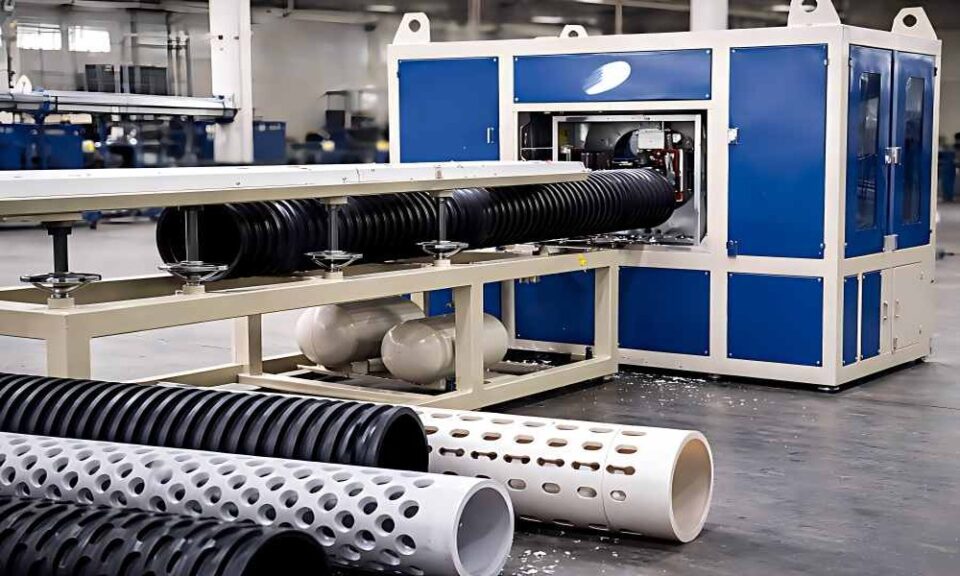
Choosing the right pipe perforating machine is important for pipe manufacturers that want stable output, accurate hole patterns, and efficient production. The right equipment can improve product consistency, reduce labor costs, and help your factory meet different drainage, filtration, and infrastructure project requirements.
1. Understand Your Pipe Material
The first step is to confirm the pipe material you need to process. Common materials include PVC, PE, PP, and corrugated plastic pipes. Different materials have different hardness, flexibility, and wall thickness, so the pipe perforating machine must be strong and stable enough to handle your specific production needs.
For example, PVC pipes usually require clean and accurate hole cutting, while PE pipes may need better clamping control because of their flexibility. If your factory produces several pipe types, it is better to choose a machine with adjustable settings.
2. Confirm the Pipe Diameter Range
Pipe diameter is a key factor in selection. A machine that is too small cannot process larger pipes, while an oversized machine may increase investment costs unnecessarily.
Before buying, list your current and future pipe sizes. If your production line covers a wide diameter range, choose a pipe perforating machine with flexible diameter adjustment. This helps your factory handle more product specifications without buying multiple machines.
3. Choose the Right Hole Pattern
Different applications require different hole designs. Drainage pipes, filtration pipes, agricultural pipes, and underground water collection pipes may use different perforation patterns.
Common hole patterns include round holes, straight slots, staggered holes, and multi-row perforations. Some projects also require holes on specific positions, such as the pipe valley or pipe crest for corrugated pipes. A suitable machine should support the hole pattern required by your end market.
4. Check Production Speed and Automation Level
Production efficiency directly affects order delivery time and labor cost. For factories with stable bulk orders, an automatic pipe perforating machine is usually a better choice. It can improve processing speed, reduce manual operation, and keep hole quality more consistent.
For small-batch production or customized orders, a semi-automatic machine may be more practical. It usually requires lower investment and offers better flexibility for changing pipe sizes or hole patterns.
When comparing machines, do not only check the maximum speed. You should also consider feeding stability, clamping accuracy, tool life, and changeover time.
5. Match the Machine with Your Existing Production Line
A pipe perforating machine should work smoothly with your current pipe extrusion and post-processing equipment. If your factory already has a complete pipe production line, check whether the perforating machine can connect with upstream and downstream equipment.
For example, you may need to match it with pipe cutting machines, slotting machines, belling machines, or packing systems. A well-matched plastic pipe processing machine can make the whole production flow more efficient and reduce unnecessary handling between processes.
6. Evaluate Machine Structure and Stability
Machine stability has a direct impact on perforation accuracy. A strong frame, reliable clamping system, accurate positioning device, and durable cutting tools are all important.
For long-term industrial production, avoid choosing a machine only because of a low price. Poor machine stability may cause uneven holes, pipe deformation, tool damage, and higher maintenance costs. A reliable machine can provide better return on investment over time.
7. Consider Customization Requirements
Many pipe manufacturers need customized perforation solutions because different markets have different standards. For example, agricultural drainage pipes may need high-density holes, while engineering drainage pipes may require larger slots or specific spacing.
Before purchasing, confirm whether the supplier can customize the machine according to pipe diameter, hole size, hole spacing, row quantity, and production capacity. Customization is especially important if your factory serves project-based buyers.
8. Review Maintenance and After-Sales Support
A pipe perforating machine is not just a one-time purchase. Long-term operation requires maintenance, spare parts, and technical support. Choose a supplier that can provide clear operation guidance, tool replacement support, and troubleshooting assistance.
Reliable after-sales service helps minimize downtime and ensures smooth operation of the production line, which is particularly important for factories with continuous order production.
Conclusion
Choosing the right pipe perforating machine requires more than comparing prices. You need to consider pipe material, diameter range, hole pattern, automation level, production speed, machine stability, customization options, and after-sales service.
For pipe manufacturers, the best machine is the one that matches current production needs while allowing future product expansion. By selecting the right plastic pipe processing machine, your factory can improve efficiency, produce more competitive perforated pipes, and better serve drainage, filtration, agriculture, and infrastructure markets.
