
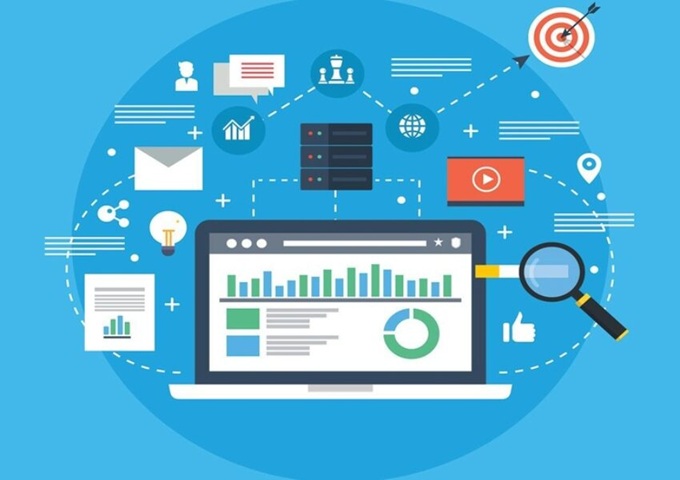
The Evolution and Scope of Digital Marketing
Digital marketing has a rich history, beginning effectively in 1990 with the Archie search engine. This early tool allowed users to find files on FTP sites, marking a quiet start to digital information access. Just four years later, in 1994, AT&T launched the first clickable banner ad, achieving an impressive 44% click-through rate in its first four months. This moment showed the power of digital reach and the potential for direct consumer interaction.
The rise of digital marketing came at the expense of traditional media. Advertising revenue from digital sources has grown significantly as a percentage of US GDP since 1995, gradually eclipsing print media. This shift highlights how consumer behavior changed, moving towards online platforms for information gathering and purchasing decisions.
It is crucial to understand the distinction between digital marketing and traditional marketing. Traditional marketing relies on channels like print advertisements, television commercials, and radio spots, which often offer broad, less measurable reach. Digital marketing, conversely, leverages electronic devices and the internet, encompassing a wide array of online methods such as search engines, social media platforms, and email campaigns.
However, the scope of digital marketing is even broader than just online marketing. While online marketing specifically refers to internet-based activities, digital marketing includes non-internet channels too. Consider SMS messages, mobile ringtones, and even digital billboards; these all fall under the umbrella of digital marketing because they utilize digital technology to convey marketing messages to an audience. This expansive scope makes digital marketing an incredibly powerful and versatile tool for businesses in May 2026.
Core Pillars of a Modern Online Strategy
Modern digital marketing strategies are built upon several key pillars, each designed to reach customers through distinct channels and methods. These include Search Engine Optimization (SEO), Search Engine Marketing (SEM), Pay-Per-Click (PPC) advertising, Social Media Marketing, Email Marketing, Affiliate Marketing, Native Advertising, and Video Marketing. Each component plays a vital role in a comprehensive digital presence.
The sheer volume of digital advertising underscores its importance. In 2010, an estimated 4.5 trillion online ads were served annually, with digital media spending experiencing a 48% growth. This demonstrates the rapid expansion and increasing reliance on digital channels for promotional efforts. Today, nearly 93% of all online experiences begin with a search engine, emphasizing why SEO and SEM are foundational to any digital strategy.
Email marketing, despite its long history, remains exceptionally effective. It boasts a median Return on Investment (ROI) of 122%, significantly outperforming many other digital channels. This high ROI makes email a cornerstone for nurturing leads and driving conversions. Furthermore, with approximately 5.9 million Google searches occurring daily, businesses have countless opportunities to be discovered by potential customers. To truly stand out and capture this attention, developing data-driven digital marketing content clusters is essential, allowing businesses to provide comprehensive answers and establish authority in their niche.
Mobile optimization is no longer optional; it’s a necessity. With people spending an average of 8.8 hours online daily, often on their smartphones, marketing efforts must be designed to be responsive, fast-loading, and user-friendly across all mobile devices.
The Role of Content in Digital Marketing
Content marketing is a strategic approach focused on creating and distributing valuable, relevant, and consistent content to attract and retain a clearly defined audience. Its primary goal is to use storytelling and information sharing to build brand awareness and foster trust. A 2019 study revealed that 75% of consumers believe content marketing builds brand trust, highlighting its critical role in establishing long-term customer relationships.
Content can take many forms, including blog posts, ebooks, infographics, videos, podcasts, and case studies. By providing useful information, businesses can position themselves as thought leaders and experts in their respective fields. For instance, a 2018 study indicated that 56% of people made a purchase after reading a blog post, underscoring the direct impact of informative content. As of May 2026, the digital landscape is rich with content, with over 600 million blogs worldwide, showcasing the widespread adoption and effectiveness of this strategy.
Content marketing is not merely about promotion; it’s a full-funnel tactic that supports customers throughout their entire journey—from initial awareness and active evaluation to the final conversion stage. It educates, engages, and persuades without overt sales pitches, building a sustainable and trusting relationship with the audience.
How Specific Channels Drive Growth
Different digital channels are leveraged strategically to achieve specific growth objectives for businesses.
Search Engine Optimization (SEO) is the practice of increasing the quantity and quality of traffic to your website through organic search engine results. This involves several key areas:
- On-page SEO:Optimizing elements directly on your website, such as keywords, content quality, meta descriptions, and headings, to signal relevance to search engines.
- Off-page SEO:Activities performed outside of your website to improve its search engine ranking, primarily through building high-quality backlinks from other reputable sites.
- Technical SEO:Ensuring the technical aspects of your website are optimized for search engine crawling and indexing, including site speed, mobile-friendliness, and site architecture.
Search Engine Marketing (SEM) encompasses both organic SEO and paid advertising efforts like Pay-Per-Click (PPC). While SEO provides long-term, sustainable traffic, PPC offers instant visibility by placing ads prominently at the top of search engine results pages. These paid campaigns can be highly targeted but require careful budget management.
Social media marketing utilizes platforms like Facebook, Instagram, LinkedIn, TikTok, and X (formerly Twitter) to connect with audiences, build communities, and drive engagement. As of May 2026, there are more than 3.4 billion active social media users globally, representing a significant audience for businesses. A 2019 survey found that 74% of social media users follow brands, and 96% of people who follow businesses engage with those brands. This makes social media an invaluable channel for direct interaction, customer service, and brand building. Influencer marketing, a subset of social media marketing, involves collaborating with individuals who have a dedicated following to promote products or services. Research shows that 61% of Gen Z and millennials trust recommendations from influencers, highlighting the power of authentic endorsements in the digital age.
The Impact of AI and Data Analytics
Artificial Intelligence (AI) and data analytics are profoundly transforming digital marketing, enabling more intelligent and personalized campaigns than ever before. Generative AI, capable of creating content ranging from ad copy to personalized email sequences, is facilitating hyperpersonalization—the tailoring of marketing messages to individual customer preferences and behaviors. This advanced level of personalization can boost engagement by as much as 56%, making interactions more relevant and impactful.
Marketing automation, a concept that gained traction around 2007, has evolved significantly with AI. It helps businesses manage routine tasks efficiently, including lead nurturing, which systematically guides potential customers through the sales funnel with targeted communications. Customer Relationship Management (CRM) systems are seamlessly integrated with these automation tools, providing a comprehensive view of customer interactions and streamlining follow-up processes. Businesses seeking effective digital marketing solutions are increasingly leveraging these integrated AI and automation platforms to optimize their outreach and customer management.
Data analytics provides the backbone for these AI-driven strategies, offering real-time tracking and insights into campaign performance. This empowers marketers to make data-driven decisions swiftly, optimizing campaigns on the fly for maximum effectiveness. Emerging technologies like Virtual Agent Technologies (VATs), which combine Natural Language Processing (NLP) and Robotic Process Automation (RPA), are enhancing customer service and lead qualification by providing intelligent, automated interactions. Furthermore, AI is advancing Agentic SEO and LLM optimization, allowing search engines to better understand and interpret complex content, ultimately improving search visibility.
Leveraging AI for Enhanced Digital Marketing Performance
AI’s capabilities extend to numerous areas, significantly enhancing digital marketing performance. It plays a crucial role in the evolution of search, supporting Answer Engine Optimization (AEO) and Generative Engine Optimization (GEO). These approaches focus on ensuring that content directly and authoritatively answers user queries, especially as search engines become more conversational and generative in their results.
AI also automates critical optimization processes, such as A/B testing, where different versions of ads, landing pages, or emails are tested simultaneously to identify the most effective elements. This allows for continuous improvement without manual intervention. Dynamic content generation, where website or email content adapts based on user data, is another powerful application, ensuring each visitor sees the most relevant information. AI further aids in sophisticated customer journey mapping, providing deeper insights into how users interact with a brand across various touchpoints.
As of May 2026, the adoption of marketing automation is widespread, with 88% of marketing organizations reporting its usage. This highlights the industry’s reliance on AI-powered tools for efficiency and effectiveness. AI’s ability to perform predictive behavior forecasting allows marketers to anticipate customer needs and actions, while sentiment analysis helps gauge public perception and brand health by analyzing large volumes of text data from social media and reviews.
Navigating the Nonlinear Customer Journey
The modern customer journey is rarely a straightforward path; it’s a complex, nonlinear process where individuals interact with brands across multiple channels before making a purchase. This means businesses need to establish multi-channel visibility to capture attention at various touchpoints. Research from 2018 indicated that nearly 90% of online consumers in the United States researched products and brands online before visiting a store or making a purchase. Furthermore, 70% of all retail purchases in the US are influenced by an interaction with a brand online, underscoring the pervasive impact of digital touchpoints.
Brand awareness is a critical component of this journey. In 2019, 81% of digital marketers actively worked on enhancing brand recognition. For B2B marketers, the emphasis is even stronger, with 89% believing that improving brand awareness is more important than efforts directed at increasing sales. This focus is particularly relevant given the longer sales cycles typical in B2B environments.
Digital marketing applies differently to B2B (business-to-business) and B2C (business-to-consumer) models:
Feature B2B Digital Marketing B2C Digital Marketing Sales Cycle Typically longer (e.g., 6-12 months) Shorter, often impulsive Decision-Makers Multiple stakeholders, committee decisions Often individual consumer Content Focus Educational, logical, ROI-driven, thought leadership Emotional, aspirational, entertainment, immediate value Channels LinkedIn, industry forums, email, webinars Social media (Instagram, TikTok), email, display ads Goal Relationship building, lead generation, long-term value Immediate sales, brand loyalty, engagement B2B sales cycles, often lasting 6 to 12 months, necessitate a focus on relationship-building and demonstrating long-term value. Conversely, B2C marketing often leverages emotional triggers and immediate gratification to drive quicker decisions. The rise of the sharing economy and the increasing adoption of omnichannel strategies further shape modern marketing. An omnichannel approach, which ensures a seamless and integrated customer experience across all touchpoints, can lead to a significantly higher purchase rate—up to 287% higher when three or more channels are used.
Overcoming Challenges in the 2026 Landscape
The dynamic nature of digital marketing presents several ongoing challenges. Rapid algorithm changes by search engines and social media platforms require constant adaptation from marketers. Ad fatigue is another concern, as consumers are exposed to an estimated 10,000 brand messages daily, leading to diminishing returns for repetitive or intrusive advertising. Building and maintaining customer trust is paramount, especially in an era marked by heightened awareness of data privacy.
Regulations like GDPR (General Data Protection Regulation) in Europe and various antitrust rulings have significantly impacted how data is collected, processed, and used in digital marketing. These regulations aim to protect consumer privacy and prevent monopolistic practices, necessitating strict compliance from businesses. The upcoming Digital Services Act further reinforces these principles, emphasizing transparency and accountability.
To navigate these complexities, strategic planning is indispensable. Marketers commonly employ frameworks like SMART goals (Specific, Measurable, Attainable, Relevant, Timely) to set clear, actionable objectives. The V2MOM framework (Vision, Values, Methods, Obstacles, Measures) provides another structured approach for aligning organizational goals with digital marketing initiatives. Businesses partnering with agencies like ClickCentric digital marketing often benefit from their expertise in implementing such robust planning methodologies to overcome these challenges effectively.
Key Performance Indicators for Success
Measuring the success of digital marketing efforts relies heavily on understanding and tracking Key Performance Indicators (KPIs). It’s important to distinguish between a general metric and a KPI: a metric is simply a quantifiable measure (e.g., page views), while a KPI is a specific metric that is directly tied to a business’s strategic goals and indicates progress towards them.
Essential KPIs in digital marketing include:
- Click-Through Rate (CTR):The percentage of people who click on an ad or link after seeing it.
- Conversion Rate:The percentage of website visitors who complete a desired action, such as making a purchase or filling out a form.
- Cost Per Lead (CPL):The average cost incurred to acquire one lead.
- Return on Marketing Investment (ROMI):Measures the profitability of marketing expenditures.
- Bounce Rate:The percentage of visitors who navigate away from a site after viewing only one page.
For instance, SEO leads have a significantly higher close rate of 14.6% compared to outbound leads, which close at only 1.7%. This highlights the value of organic search efforts. To accurately attribute conversions across the nonlinear customer journey, multi-touch attribution models are employed, crediting all contributing channels rather than just the last one. High-performing marketing teams prioritize real-time performance monitoring, with 72% analyzing data in real-time to make swift, informed adjustments to their campaigns.
Frequently Asked Questions about Digital Marketing
What is the difference between digital marketing and online marketing?
Digital marketing is the broader term, encompassing all marketing efforts that use an electronic device or the internet. This includes online channels like websites, social media, and email, but also extends to non-internet digital channels such as television ads, SMS messages, and digital billboards. Online marketing, on the other hand, is a subset of digital marketing that specifically refers to marketing activities conducted exclusively via the internet.
How has AI changed the way local businesses approach SEO?
AI has fundamentally shifted SEO from a keyword-stuffing game to a more sophisticated, user-centric approach. Local businesses now need to focus on Answer Engine Optimization (AEO) and semantic search. This means creating content that directly and comprehensively answers specific user queries, often in a conversational tone, rather than just optimizing for keywords. AI-powered search engines are better at understanding the intent behind a search, requiring local businesses to provide authoritative, relevant, and localized answers to complex questions to rank effectively.
Why is brand awareness considered more important than direct sales in B2B?
In the B2B sector, sales cycles are typically much longer, often spanning 6 to 12 months, and involve multiple decision-makers within an organization. During this extended period, establishing strong brand awareness and authority is crucial. It builds trust, credibility, and familiarity with potential clients long before a purchasing decision is made. By prioritizing brand awareness, B2B companies ensure they are top-of-mind and perceived as reliable experts when a client is finally ready to engage, laying the groundwork for eventual sales and long-term partnerships.
Conclusion
As we look to May 2026, digitalmarketing continues its rapid evolution, becoming an increasingly intricate and indispensable component of business success. The emphasis on omnichannel integration, where all marketing efforts work in concert to provide a seamless customer experience, is paramount. Future trends will undoubtedly focus on strategic agility, the continuous refinement of AI-driven tools, and the cultivation of authentic relationships with customers.
Effective data governance and a relentless focus on the customer experience will remain top priorities, especially as privacy regulations evolve. With Gartner projecting that 80% of B2B sales interactions will occur digitally by 2025, understanding and mastering this digital transformation is not just an advantage—it’s a prerequisite for sustainable growth and competitive relevance. By embracing these principles, businesses can navigate the complexities of the digital landscape and forge lasting connections with their audience.
